The red-scare of the 1950s, in which Good Night and Good Luck is set, is not all too different from the political situation of 2005. To me, both periods in American history are scarred with government-induced fear. In both cases the American government fabricated a false enemy that did not actually exist in order to manipulate American citizens. The title of “communist” was one of the worst slanders a person could get, when in reality most citizens in America had no idea what Communism was. Joseph Stalin was portrayed as a tyrannical leader who would slaughter anyone in his path to conquer the world. While Joseph Stalin was responsible for many horrific acts of mass murder, most Americans had no idea that their own government had supported Stalin at one time. A similar situation occurred in 2005. Americans were told to fear and loath Saddam Hussein, a leader that had long been supported by the American government. Neither dictator was a huge threat to American well-being, but both went against what the American government wanted. Americans today need to understand that their government, time and time again, has intentionally sparked fear within the country for the sole reason of controlling its people.
Thursday, October 21, 2010
Andersson Good Night Red Scare
The red-scare of the 1950s, in which Good Night and Good Luck is set, is not all too different from the political situation of 2005. To me, both periods in American history are scarred with government-induced fear. In both cases the American government fabricated a false enemy that did not actually exist in order to manipulate American citizens. The title of “communist” was one of the worst slanders a person could get, when in reality most citizens in America had no idea what Communism was. Joseph Stalin was portrayed as a tyrannical leader who would slaughter anyone in his path to conquer the world. While Joseph Stalin was responsible for many horrific acts of mass murder, most Americans had no idea that their own government had supported Stalin at one time. A similar situation occurred in 2005. Americans were told to fear and loath Saddam Hussein, a leader that had long been supported by the American government. Neither dictator was a huge threat to American well-being, but both went against what the American government wanted. Americans today need to understand that their government, time and time again, has intentionally sparked fear within the country for the sole reason of controlling its people.
Saturday, October 9, 2010
Motsinger GN&GL
During his time Edward R. Murrow was popular because people could put their trust in his news. I'm sure in the present day he would be popular, because he would search out the truth-- as he did when he exposed senator McCarthy's tactics. I'm sure he was biased in some cases; but it's impossible to be unbiased completely, especially when it comes to news. Roulakis - Good Night and Good Luck
Was George W. Bush just as out of line with his “weapons of mass destruction” as Senator McCarthy was with accusing people of being communists? I think Goodnight and Good Luck was trying to ask that question. In 2005, we didn’t actually know for sure whether or not any of the countries we were accusing of having these weapons actually had them. The same thing happened in 2005. McCarthy found an enemy that everyone could hate and created this paranoid mindset that most Americans could relate to. The enemy in the 50’s was the Soviet Union, and the enemy that was created shortly after 9/11 was Iraq.
George Clooney must have very intentionally released this movie two years after our invasion of Iraq. This point could probably be defended, but the timing of the movie makes it seem as though he wanted to make a point that Bush was being as crazy as McCarthy by using this phrase. The entire movie is about these journalists trying to prove how McCarthy’s fear tactic is unjust, and I think Clooney was trying to hint that Bush’s was as well.
Leary-Good Night and Good Luck
The second cinematic technique I chose was how this movie has a lot of close up shots and tight frames. Every time the camera zooms in on a persons face, you actually feel like you are right in front of that person, actually talking to them, which makes it so much more personal. It makes the audience feel like they are dealing with the conflict with the person whose face is zoomed in on. Each time the camera does a close up, it seems to also have a tight frame. This tight framing shows that whoever is zoomed in on is in a very tight position and doesn’t have much room to move. I saw many tight frames where the person was in a very difficult situation where they didn’t really know what they should do and what was right or wrong (black and white). I think using tight framing was a very smart idea that also made the audience feel the stress that the characters were feeling which made the movie very relatable.
The last technique I chose was the indoor shots. The shots in this movie were all indoor shots that were pretty much all in the television-recording studio. The indoor shots make the characters in the movie seem trapped in one area. These shots also make the characters not have much room to move since they are taking on such a serious issue that will affect everyone watching their television show. Since they are never outside, it may seem like they will never see daylight. What I mean by this is that they are trapped indoors with the communist issue and since the shots are never outside, they might never see the sunlight as in happiness or peace. This relates to the plot of the movie because the characters are taking on a very serious issue that the characters feel troubled by. I think the indoor shots were a very good, creative idea. I would of never thought about the relationship between the shots being in doors and the struggle for room to move. It is a very interesting idea that makes the movie even better.
Overall, I believe that all three of these cinematic techniques were great ideas that helped the movie prove its point. All of these techniques sent out the message that Murrow and the television crew were trying to do what was right but ended up with tough decisions that trapped them between what is right and what is wrong.
Lucio Good Night and Good Luck
There are amazing similarities between the events which took place in the film Good Night and Good Luck to what was going on in 2005 during the film’s release. The movie is set in 1953 with all the horrors of Hitler and World War II still fresh in the minds of the American people. American media was antagonizing anything and anyone whom they believed to be a threat to American society, specifically the communists. Senator Joseph McCarthy simply used this fear for his own personal gain, falsely accusing hundreds of people of being communist. Because of the general American fear and animosity towards communists, very few people were willing to speak against him. This McCarthyism is all too similar to the events which took place in 2005. After the horrific terrorist attacks on the World Trade Center, the American people gained a similar fear and animosity towards terrorists, Muslims, and pretty much every middle-eastern country in general. Thus, George Bush was able to use this fear and heightened sense of American patriotism to his own advantage. Just as McCarthy shouted terrorist, Bush shouted WMDs, both accusations being void of any real proof or confirmation.
Rivera: Good Luck America
The film is based on Edward Murrow's public attempts to reveal McCarthy's completely ridiculous witch hunt for what it truly was. It wasn't a ploy to reveal potential communists within the US government, but a ploy to shine light on his career. The film was made at an important time in modern US history, the reelection of bush just occurred, and the war in the middle east is still underway, and maybe most importantly, there still has been no discovery of WMD's in the Middle East. The similarities between the film and the events occurring 2005 are clear; should we stand by and accept what our government tells us? As Murrow said, “Our history will be what we make of it”.
“The war on terror” has received plenty of controversy, and very little praise, sense the events of 9/11. It seems as though our government is constantly issuing statements, only later to retract or change them to correct errors. All the while expecting the American people to stand by and mindlessly accept any information given as proof. Murrow's statements then, are just as important to us now, for the issue he was speaking of remains never-ending; no matter how afraid we are, no matter how severe the punishment, the most important thing we can do as people is to always stand up for what is right. The government says there are WMD's in Iraq? Prove it. McCarthy says he knows there are communist ties in our government? Where was his proof? Murrow shows there is no wrong in deciding your government can be wrong. “We must not confuse dissent with disloyalty. When the loyal opposition dies, I think the soul of America dies with it.” He is saying do not lose ourselves, not just as individuals, but as a nation. By standing by and letting our government lie to us, to bring terror into our hearts and offer no proof is simply unacceptable. Today, with war still in the Middle East, it is hard to say if Murrow would be heard by Americans. The events of the 1953 Red Scare were so easy to continue because the government was able to instil fear into Americans by creating an enemy, Stalin, Socialist governments. The government said they were going to protect us from the evils of Stalin, so we allowed them to feed us, we accepted their safety without question. In 2005, Americans believed they had a clear idea of who the enemy was, there was no need for the government to paint us a picture. Yet, they did. They told us “these people over here are enemies, and so are these people, they have these weapons and they want to hurt us”. Well again, Americans wanted to feels safe, safer than after 9/11. See, the events of 9/11 changed America, maybe shook us back in time even. It brought us back to a time when we were afraid, and all we wanted was safety. Our government was the source of that safety. America had been pushed back to the state that Murrow had warned us about, just like in 1953. Edward Murrow was a very persistent man in '53, and he would be just as persistent today. He would not accept conviction without evidence then and would not do it today. It's hard to say if he would be heard by American people today however. I mean, he said it then, so why did we stop listening?
Calderon Good Night and Good Luck
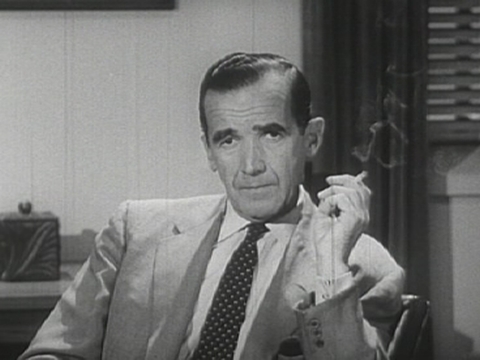
Black and white photography sets a completely different mode for the movie. It mainly focuses on a speech from Edward Murrow, but the black and white photography captures the audience into the era. George Clooney wanted to set the stage for the feel of the 1950s. The black ties and crisp white shirts with smoke in the background are a meticulous example. The inside shots also very clearly reveal how people in the 50s worked in offices. Every scene is inside and in the studio. It really shows the seriousness about work and how much work was put into the show. The tightness and extreme close-ups, especially on Edward Murrow, show the seriousness again & focus solely on Edward Murrow. He was the leader and he stood up against McCarthy, so he had to be the sole focus. The picture posted here again demonstrates the closeness of the team working in the studios. The shot is medium closeness so it is not completely focused on one person. They were a team, so it shows how they always worked together. Altogether, the cinematography of black and white gives the movie a sort of history feel to it. It seems as though it is a history movie with the black and white, but it is perfect in black and white. It would definitely not have the same feel if the movie were in color.
Cassimere; Good Night and Good Luck
The use of tight framing, all indoor shots, and black and white photography gives the viewer a sense of anxiety and allows them to identify with the characters. Cinematography aims at making the viewer feel as if they are with the characters in the movie, and in this case, the cinematography causes the viewer to almost experience the same pressure and anxiety that the characters in the movie are experiencing. The makers of Good Night and Good Luck wanted the audience to feel like they were in the same situation as the characters in the movie.
Most of the situations in the movie are very tense, and the tight framing emphasizes this tension. Characters are placed on the edges of the screen and given very little room to move around. This focuses the viewer’s attention to only the person speaking, which, in my opinion, causes the viewer to pay critical attention to what the person is saying. Tight framing also gives the impression that the characters can sense the small amount of space around them, which adds a claustrophobic element to the scene. The use of only indoor shots adds to the claustrophobic element. Outdoor shots offer a sense of relief and openness, which is not found in this movie.
The use of black and white photography gives the movie a vintage look, as if it were made in the same year it is set in. I think it is important that the film was shot in black and white because it adds to the ability of the audience to identify with the characters. It also makes everything a little darker, which I think adds to the anxiety factor of the film as well.
Lanaux Good Night and Good Luck
The use of black and white photography gave the film a classic and realistic feel. I thought it was interesting because not a lot of movies made these days are shot in black and white. I like old movies so the photography made the movie stand out to me compared to other movies that take place in the past. Whenever Murrow was doing his television program, it looked like I was watching the actual event rather than a reenactment.
Friday, October 8, 2010
Nguyen Good Night and Good Luck
Good Night and Good Luck is a film that attempts to show us what happened during the time of the red scarce brought on by Senator McCarthy. The film itself uses different cinematic techniques to make the film feel as though it was made in 1953 as well as incorporating different forms of symbolism.
The most obvious technique is the fact that the movie is in black and white. The lack of color allows the audience to imagine as if they were watching the events of the red scare as it was happening in 1953. It adds a realistic yet fictional aspect to the film. The lack of color also shows that the situation with the communist was also black and white. It was clear that what McCarthy was doing is wrong, yet no one had the courage to stand up to him because they feared retaliation.
Another key technique are the constant close ups with the many characters. The close-ups allow Murrow, the newscaster, to be more intimate with the viewers. It creates a more intense and personal atmosphere throughout the movie because the red scare was a serious matter that endangered many innocent lives. The close-ups also showed that Murrow was taking the situation very personal even though he never really admitted it.
A subtle element of the film is that all the shots of the movie was made inside never outside in the open. Symbolically it shows that the communist threat was affecting people’s personal lives within there home and not just the outside world. The mere assumption that a person was affiliated with the communist party does not ruin just the individual’s life but the lives of his family as well.
Thursday, October 7, 2010
Parsons: Feeling of the 1950's
Good Night and Good Luck is filmed in a way that emulates the way television looked in the 1950’s. Because television was a new medium, usage of cameras and sound systems were in their infancy. All television had to be filmed in studio and close-ups were typical to show people’s facial expressions more clearly. This film creates this atmosphere that puts the audience into the 1950’s, not only by imitating the film techniques, but also by creating a tense, claustrophobic environment that shows the feeling of the time period. Indoor shots, many close ups, and tight framing made the film feel more like its time and affected the way I watched the movie.
Good Night and Good Luck was filmed in the best way for the affect that director George Clooney wanted to achieve. I watched the film with a feeling of unease. The movie itself was stark and beautiful with amazing shots and great visual images. Incorporating actual footage from the 1950’s, and pairing that with modern film done as antique made the movie really powerful because it made the audience feel like we were really experiencing the events surrounding the McCarthy hearings. Not only did the all indoor shooting make the film seem like it revolved in its own world, but it made us feel like their was no escaping the incidents of Murrow taking on McCarthy and we were right there through the pressure with CBS. The close ups and tight framing added to this feeling. The close ups made us feel like we were talking with Ed Murrow himself, and this was like his actual TV show from the 50's because it was usually just close up shots. Overall I liked the way Good Night and Good Luck was filmed because it added so much to the movie that would not have been there if filmed normally.
Farris - Good Night and Good Luck
On the surface, Good Night and Good Luck is about the Red Scare prevalent in the United States in the 1950s in which Americans lived in constant fear of the infiltration of the government by Communists. But, since this film was released in the early 2000s, it can be said that the underlying message of the movie is actually about the “terrorist scare” that was witnessed in the U.S. after the 9/11 attacks in 2001, and is still very much felt to this day.
Senator Joseph McCarthy’s televised proclamations about known communists in the government and in Hollywood did what they were meant to do: instill fear into the American public. These claims, however, were not exactly justified because there was no real proof to back them up, but they were still widely believed anyway. Similarly, President George W. Bush and members of his cabinet made public claims about the confirmed existence of weapons of mass destruction in the Middle East, which also lacked in proof to back them up.
A country in fear is extremely gullible, and is even willing to give up certain freedoms in order to feel safe. In the 1950s, phone taps were widely used to track down “Commies.” After 9/11 the Patriot Act was passed, allowing the government to have access to people’s emails, phone conversations, and other records. Whether these methods are effective are debatable.
Yes, I do think that Edward R. Murrow would have been as successful today as he was in the 1950s, although he would need have used a few different methods. People today simply do not watch television as diligently as they did in the past because there are so many other forms of entertainment available, especially via the internet. In order to be heard, Murrow would need to adapt his message to these technologies.
del Valle, Good Night, and Good Luck
“His primary achievement has been in confusing the public mind, as between internal and the external threats of Communism. We must not confuse dissent (opposition) with disloyalty. We must remember always that accusation is not proof and that conviction depends upon evidence and due process of law. We will not walk in fear, one of another. We will not be driven by fear into an age of unreason, if we dig deep in our history and our doctrine, and remember that we are not descended from fearful men -- not from men who feared to write, to speak, to associate and to defend causes that were, for the moment, unpopular." (“Of Murrow, McCarthy & Miller” by Jim Emerson)
In the film, Good Night, and Good Luck, there are many uncertainties surrounding Joseph McCarthy and his approach towards “ridding the country of communism”, that are pointed out in newscasts by the reporter Edward R. Murrow. Joseph McCarthy attempted to gain the support of the country through propaganda, “half-truths”, and some “outright lies”. For example, he had claimed that the American Civil Liberties Union was reported as a Communist Party in disguise, however he was never able to state who had reported the group as this, in fact, there was evidence proving this group as the opposite, as a group known to never have been reported as dissident. McCarthy used lies to not only persuade the country, but to also confuse them into consent, convincing them that those being prosecuted were threats to the country in their loyalty to communism and disloyalty to America. He also had a way of confusing disloyalty with disagreement. He seemed to forget that in our country that all people are innocent until proven guilty. Similarly, in 2005, there was skepticism revolving the Bush and Cheney administration and their choice to begin a war with Iraq. The basis of their choice was evidence they claimed to have that proved that there were Weapons of Mass Destruction being made in the country. However, similar to the way McCarthy’s accusations were always just that, and not based on actual facts or evidence, but instead based more in falsehoods, the “discovery” of the weapons, also, was just an accusation, and when further investigated was in fact proven to be false. However, the government continued on their track, insisting the evidence, which had been falsified, still gave reason to start the invasions and wars. McCarthy’s accusations has more evidence opposing his beliefs, however he carried on with his persecutions, similarly the administration in 2005, did the same. When Cheney received documents from the British, from the Italiams, claiming to confirm Iraq’s purchase of uranium of Niger, the CIA was notified and called for a further investigation of the situation, when the investigation was complete, it was verified that the documents were forged, however, the administration still referred to these documents as a form of validation or as a motive for their actions.
Considering the similarity of the two situations, I think Edward R. Murrow would be successful had he taken the same approach in 2005 that he did in 1953. I don’t think it would happen right away, however, I think, through a few steps, he would gain the support of the country. Through presenting the public with the facts, based on evidence, that would prove the government was lying, he would raise doubts in the public, and therefore make them question the administration. Then through his persistence in presenting these truths, he would eventually persuade, some, and possibly all of the public, to see the truth. Finally, he would gain their full support when pointing out things such as how the government is hurting the public in their decisions, creating a “common enemy”, and then by pointing out that our country was based on the idea that everyone is innocent until proven guilty, and without proper evidence supporting otherwise, those being attacked are not guilty.
Wednesday, October 6, 2010
Whitlock Good Night and Good Luck
2) This movie was released very timely in the United States. The war in Iraq seemed to be going nowhere fast in the search for WMDs. We were all told that they were definitely there, just like McCarthy told everyone that communists were definitely in our government. Our country was scared that there might be WMDs and we would be defenseless, just like the Red Scare in the 1950s.
The government lied to the people of the United States, both in 1953 and in 2005, and they were caught both times. Journalists were a huge part of getting the truth out to America. In 1953, the CBS program, See it Now, bravely stood up to Senator Joseph McCarthy when almost everyone else was too afraid to do so. In 2005, many journalists acted as watchdogs for the government in many articles to show how the government was lying about WMDs, including an article in The New Republic.
When this movie came out, I'm sure a lot of people quickly noticed the correlation because what happened then and what was happening now. I think that it gave many people a call to action and to not believe everything that they are told. It also showed that maybe the government doesn't always have our best interests at heart because in 1953, they were willing to persecute so many innocent people for just living their lives, and in 2005, they allowed so many young men and women go overseas and die for something that they never should of had to. I think that by having this movie come out when it did, it allowed us to open up our eyes and see that the government does make mistakes, sometimes very monumental ones, and that we shouldn't just believe what they tell us to.