Showing posts with label Eleni Roulakis. Show all posts

Thursday, December 2, 2010

Roulakis - Traffic


The Wakefield family is a wealthy family that lives in Ohio. This family includes a prominent father figure who is not only a judge, but now the head of the President's Office of National Drug Control. Though this movie is about drug trafficking, it shows how and why drugs are a part of each character's life. Robert Wakefield's daughter, Caroline, is sixteen years old, at the top of her class, and an honor student. Throughout the film we slowly see how her experimentation with drugs turns into an addiction and eventually leads her on a path that could destroy her life. Her addiction, and her father's persistence to stop the drug cartel's in Mexico end up impacting each other's lives more than they could imagine.
Robert Wakefield believes that he can win the war on drugs on both a political and social level. He speaks to the public, travels around the country and even to Mexico to meet with important political figures that could help him "win" this war. However, he never looks at his own home and how what he really needs to do is look at how drugs are effecting him and his family on an individual level. In the end, he realizes that it is the only way that he can win the war that's almost impossible to stop. He was so busy trying to stop all these powerful and corrupt people, that he and his wife did not even realize how bad their daughter's addiction to cocaine was getting. Eventually, at the end of the movie when Wakefield is giving a speech for the press at the White House, he realizes that a war on drugs was actually in his own home, and that he couldn't contribute anything to his country before helping his own family. During Caroline's second time in rehab, the audience can actually tell that she is willing to get better and is happy that she is getting help. After she gives a touching speech the camera falls onto her father who is asked to respond to her speech and he says, "My name is Robert. And my wife, Barbara and I are here to support our daughter Caroline. And we're here to listen." This is when I believe the Wakefield family has won the war on drugs - on an individual level.

Roulakis - American History X


Though I believe the intent of the movie American History X is to show that Fascism/Nazism should not be tolerated, there are a few scenes which show WHY people are attracted to it. The main reason is that it gives people a sense of power, and it's widely known that whenever people are given power, they love to run with it. A scene that shows how Fascism/Nazism could be attractive to young people in particular is when Derek and his friends play basketball against a group of black men and the winners get to take over the courts. Though the "whites" start to struggle, Derek eventually comes in, takes his shirt off displaying his enormous swastika tattoo, and simply just looks like a strong leader. He speaks eloquently, turns out to be a great basketball player and he leads his team to victory. Young teens are taught that being the leader of an organization is a great, strong thing to do, and Derek has the characteristics of a strong leader. Though he leads an evil organization, in this scene particularly, it looks like he's doing something good. What makes this scene even more attractive is that Danny, who is a young teen, is inspired by his older brother's actions. We know this because the scene is one of Danny's memories, and as he is describing what happened on the court that day he talks about how great of a place Venice Beach used to be before all the black gangs took over and it became a violent place. This scene makes Derek not only look like a hero to Danny, but to the entire community.

Friday, November 12, 2010

Roulakis- State of Play

Privacy is necessary for a democracy to flourish because it is needed in order for this government to be one. Intruding on a person’s privacy would mean that the government does not trust its people. However, most importantly this shows that government, and even worse, corporations have an undemocratic power over individuals.

While there are several scenes that show how individual’s privacy are invaded, the first few minutes of the movie really sets the stage for the rest of the movie. We see Sonia walking, and the way the camera is positioned, it is set as though someone is hiding and watching her, which we eventually find out is true. What makes this scene so important is that it makes it easier for the audience to assume that this was not a suicide- and that someone that was following Sonia was in fact trying to harm her. When we eventually find out that PointCorp was behind what happened to her, it shows how corporations having so much control over the country/government can really effect people's lives.

Saturday, October 9, 2010

Roulakis - Good Night and Good Luck


Was George W. Bush just as out of line with his “weapons of mass destruction” as Senator McCarthy was with accusing people of being communists? I think Goodnight and Good Luck was trying to ask that question. In 2005, we didn’t actually know for sure whether or not any of the countries we were accusing of having these weapons actually had them. The same thing happened in 2005. McCarthy found an enemy that everyone could hate and created this paranoid mindset that most Americans could relate to. The enemy in the 50’s was the Soviet Union, and the enemy that was created shortly after 9/11 was Iraq.

George Clooney must have very intentionally released this movie two years after our invasion of Iraq. This point could probably be defended, but the timing of the movie makes it seem as though he wanted to make a point that Bush was being as crazy as McCarthy by using this phrase. The entire movie is about these journalists trying to prove how McCarthy’s fear tactic is unjust, and I think Clooney was trying to hint that Bush’s was as well.

Friday, October 1, 2010

Roulakis - Inglourious Basterds


My favorite character in this movie was Colonel Hans Landa. Christopher Waltz played this role magnificently and although I hate to say “the bad guy” was my favorite character, he was. This character constantly gave me the chills and continuously kept me guessing whenever he was in a scene. The first scene in particular with the dairy farmer created a distinct character that we could recognize throughout the movie. There is constant irony whenever he is in a scene and he easily instills fear to his victims as well as the audience (me!). For example, in the first scene when he asks the dairy farmer to use his pipe, he brings out this huge pipe, basically showing that he believes he is bigger, more important than others. Something else that makes him stand out is that he is always acting and playing a role as the detective. He is constantly playing dumb, and often uses comedy to “lighten” situations before preparing what is normally a verbal attack on his victims. In every scene he questions his victims, he acts friendly and plays mind games. His dialogue is normally somewhat comical and he often uses silly expressions.

The scene with the dairy farmer is shot in a social setting while he is questioning him, and he is pretending to not know that he is hiding anyone. Normally you can see the both of them up until he stops his act, the camera zooms into his face, making it an intimate shot. This is when he confronts the farmer about hiding Jews in his home. The camera then switches to the farmers face and it keeps switching back and forth to the characters as the farmer confesses, zooming in closer and closer to their faces as their conversation continues. The lighting in this scene is somewhat dark, which is because the daughters close the window, but it creates a dim mood which makes the viewer understand that something bad could potentially happen.

Friday, September 17, 2010

Roulakis - Good

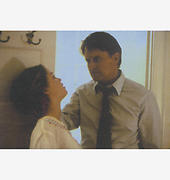
I believe the film is entitled “Good,” because it has to do with main character, John Halder’s, fight between good and evil. Because Halder was pressured and didn’t necessarily choose to become a Nazi, we can assume that he is a decent human being. However, his actions later on in the movie contradict the title. As time goes on, although he kept his own personal values, he still became an infamous SS officer and never stayed true to what was actually “Good.” I think the title of the movie is supposed to make us decide whether or not Halder maintained a good person simply because he never changed his personal morals and ideals, or if he was evil because he wasn’t actually being true to himself by still being a part of the Nazi regime. The picture posted is of him and his new wife, Anne, at a Nazi party. In this scene, they are confronted by his ex father in law. I think this picture has to do with the title of the film because again, in this frame, Halder is trapped in so many ways. He was trapped in a difficult marriage, and left his wife and children for another woman, he is a member of the Nazi party. He is a good individual, but his pressured actions show differently.

I don’t think this movie was not distributed in the US due to a government decision. I just think that it was not distributed by the company that made this film because they assumed it wouldn’t do well with an American audience. This is most likely because I feel like American audiences wouldn’t do well with sympathizing with a Nazi, although it is a different point of view, and not a story that we have seen yet in the US.

Friday, September 10, 2010

Roulakis - W


I think one of the best scenes that most reveals the character of George W. Bush is the scene where he’s eating lunch and meeting with the vice president, Dick Cheney. They are eating lunch together because Cheney wants to discuss what the possibilities of Iraq having nuclear weapons is. He puts together a proposal and uses a metaphor to help the president understand his idea. He asks Bush if he would eat his sandwich if he knew there was a 1% possibility that the lettuce contained E-Coli. Bush stares at his sandwich for a moment and then says “No.” Cheney the says that the majority of Americans would still eat the lettuce. Obviously, Cheney is actually talking about the 1% chance that Iraq has nuclear weapons and whether or not to invade based on that small statistic.

This scene showed how stubborn Bush is with his stance, and how he dislikes other people telling him what to do. Throughout the movie, we can see the relationship between him and his father. This is an important theme that we see several times, and the low standard his father puts on him. I think that in this scene, we see Bush trying to compensate for the condescending attitude that his father shows towards him, especially when he reminds Cheney that Bush is the president, not him. This scene shows how important it is for Bush to be reminded that he is in charge for once.


Thursday, September 2, 2010

Roulakis - West Wing Pilot


In "The West Wing" pilot episode that we watched, the President's cabinet was being pressured by a religious group. The President's Deputy Chief of Staff, Josh Lyman, was aired on a TV show and scandalously stated "Lady, the God you pray to is being indicted for tax fraud." While there were several political issues that were shown within the White House, the most pressing were the consequences of Josh's actions. An extremist religious group called "The Lambs of God" comes to the White House in an attempt to make a deal with some of the cabinet members. They give three of the cabinet members, including Josh, three options for the President to make public remarks about: public morals, school prayer, or pornography. After some arguing goes back and forth, the president eventually comes in at the moment where one of the extremists states the first commandment incorrectly. He yells the correct first commandment and then goes on a tangent about how much he dislikes the group, and eventually kicks them all out.

It was interesting to see how instead of simply accepting an apology from Josh Lyman and the rest of the cabinet members that were present, The Lambs of God wanted something in return for denouncing their God on TV. It makes me wonder if the President is actually ever bribed like that, because it seemed very real. I think the way the President in the show handled the situation was incredible, considering the religious extremists' attitude.