Though I believe the intent of the movie American History X is to show that Fascism/Nazism should not be tolerated, there are a few scenes which show WHY people are attracted to it. The main reason is that it gives people a sense of power, and it's widely known that whenever people are given power, they love to run with it. A scene that shows how Fascism/Nazism could be attractive to young people in particular is when Derek and his friends play basketball against a group of black men and the winners get to take over the courts. Though the "whites" start to struggle, Derek eventually comes in, takes his shirt off displaying his enormous swastika tattoo, and simply just looks like a strong leader. He speaks eloquently, turns out to be a great basketball player and he leads his team to victory. Young teens are taught that being the leader of an organization is a great, strong thing to do, and Derek has the characteristics of a strong leader. Though he leads an evil organization, in this scene particularly, it looks like he's doing something good. What makes this scene even more attractive is that Danny, who is a young teen, is inspired by his older brother's actions. We know this because the scene is one of Danny's memories, and as he is describing what happened on the court that day he talks about how great of a place Venice Beach used to be before all the black gangs took over and it became a violent place. This scene makes Derek not only look like a hero to Danny, but to the entire community.
In the movie, American History X, the scene that stood out to me the most was the scene where Derek is getting put in handcuffs. This particular scene really seems to send a white supremacy message to the lower-class racist young people, especially white males, in the world. The reason lower-class racist white males would pay attention to this scene would be because it shows a white racist male being very powerful and showing his racist thoughts towards blacks. This audience would probably take pride in this scene and rather enjoy it. The reason this scene illustrates the idea of Nazism attracting this specific group of young people is because Derek seems to be someone to look up to for this class of people. He has a huge Nazi sign across his heart showing that being racist towards Nazis is what is in his heart and what is most important to him. He is also smiling in this scene when he is being put into cuffs, showing that he is proud of what he has done which would make this audience also feel what Derek is feeling.
This scene starts of with Derek running outside and shooting the two men breaking into his car. Immediately, the audience realizes the scene is in black and white meaning that it is a flashback. This black and white filming makes the audience truly realize the segregation going on in these flashbacks. This symbolizes that there are no grey areas, just black and white meaning that the African Americans and Caucasian whites do not mix well together. This already makes the audience feel the sense of tension between the two races.
Even though this scene is pretty long, the main part that I thought was an example of white supremacy that sent a message to a group of young people was right when the police came. After Derek killed one man by shooting him and killed the other by stomping on his head then spitting on him, the cops showed up. There is a lot of soft music in this scene and not a lot of voices which shows that what is happening in the scene is very important. This makes it so that the audience only focuses on the characters in the scene. The music playing almost calming. I think they chose this music because it sort of calms the audience down since what just happened what very disturbing. This music might of also been chosen to represent that what Derek did was not something horrifying in his eyes. You see Danny’s face in a close up, staring at Derek in disbelief. The close up makes the audience feel close with Danny and feel what Danny is feeling. Close ups tend to make the audience relate to the character on a better level.
Next you see the cops yell at Derek to put his hands on his head. Derek looks very powerful in this stance because his Nazi sign is very bold and dark over his chest. This sign is standing out because he has just killed two men and by seeing him smile while seeing this sign seems like he is very proud of being racist. Derek also looks very powerful by the way the camera is slightly tilted upward, which makes it seem like we are looking up to him. You can see Derek’s muscles in this scene, which adds to how powerful Derek looks. When Derek puts his hands on his head, he faces Danny and has a strange smirk on his face. He is smiling as if he is proud of killing two men that didn’t deserve to actually die. It was a bit strange at first to see him smiling while being taken away to jail for murder but then you realize why he is actually smiling. This also seems to show white supremacy since Derek looks like he is a powerful white males that is superior to the black men he has just killed.
In the article we read, it talked about how this movie was a racist movie where whites are superior to other races. Even though I don’t think that the movie as a whole is a racist movie, but many scenes individually are very racist. This scene in particular is one of the most racist scenes in the movie, which agrees to what the article was saying about white supremacy. It also states in the article that blacks are stereotyped as violent thugs, which is supported by this scene since the blacks were breaking into a car. It also says how white characters are shown as the heroes, which is also supported by this scene because Derek is acting as a hero that stopped blacks from committing a crime.
The most noted scene that expresses Fascism and Nazism propaganda is when Cameron sent Derek to the kids that felt out of placed, neglected, and always getting beaten, mainly by the blacks and Mexicans. Derek would feed the kids information about minorities that would skew their minds of the white kids into believing anything Derek said and do anything he told them too. Derek’s followers do not have anywhere else to go or let out their frustration. This gang makes them feel like they are a part of something. As a pact, they are less likely to be picked on and, if they are bullied, they are stronger as a group. Within the group, they form friendships that are created through a common belief based on white supremacy. The group acts out on these beliefs by causing vandalism and minor crimes. In this scene specifically, Derek and his new members vandalize a Korean owned market.
The scene of Derek recruiting the white people is filmed in black and white because that is how these people saw the world. What was not white was not acceptable through their eyes. The lighting is dark in this scene as well because it is during the night. The darkness also shows how convoluted the minds of these kids and younger adults really are. Their beliefs and social situation express ignorance to their surroundings. They are unable to realize the importance of others. The close proxemics displays a close relationship between Derek, the group, and how they share a simple mindset of Nazism. Derek immediately grabs the audience’s attention with his white supremacy propaganda. This establishes exactly how serious his views are.
In the article, it talks about how Derek was already forming some racial beliefs before meeting Cameron. In the movie, it is learned that the reason these beliefs were forming was because of his father who planted the seed for his racial ways of looking at the world. Black stereotypes are expressed in the article as a major recurrence within many “anti-racial” movies. Although the hero overcomes his ignorance, the movie is filled with blacks with stereotypical characteristics and situations. However, the stereotypes mentioned in the article are placed to give the movie a more racial aspect. After all,it is a movie about racism.
Throughout the movie, Inglourious Basterds, I favored the character, Shosanna Dreyfus. Shosanna was introduced at the very beginning of the movie when Col. Hans Landa and his men shot her family. She luckily escaped and made it to France where she inherited a theatre, Le Gamaar, from her Aunt. She then met a German soldier who seemed to fall for her the minute he laid eyes on her. He convinced Goebbels to move the movie premiere to Shosanna’s theatre so that he could get closer to her. Shosanna thought it would be the perfect time to get revenge on the Nazi’s for killing her family and burn down the theatre.
The reason I favored Shosanna out of all the other characters is because she stood up for what she believed in, and was very strong even after what had happened to her at such a young age. She knew that what the Nazi’s were doing was wrong and that since no one was standing up for the Jews, she would have to. She was brave enough to risk loosing her life and her whole theatre just so she could make a point that if the Nazi’s go around acting like killing Jews is okay, then she can burn down the theatre, killing them all. She knew that killing these specific Nazi’s would end it all.
One particular scene that really describes Shoshanna’s bravery was when her face was projected on the big screen, telling the Nazi’s that they are all going to die. This scene starts with Shosanna saying that she has a message for Germany. She is the dominant in the scene since it is a close up on just her face, she is towering over every one making it so that she seems more powerful, her face is the center of the screen, and she is in black and white while the rest of the picture is in color which makes her really stand out among the crowd. This scene has very low-key lighting on everyone in the room but her. The lighting in the movie playing on the screen makes her face look very dark gray that really seems to stand out which may mean that she has this dark side of her. Throughout this scene, people in the audience start to stand up and shout at the screen, but her voice over powers everyone else’s and the people also look very inferior compared to her. After this, the screen starts to go up in flames. Shoshanna starts to do an “evil laugh” while the fire starts to burn her face. This seems to send kind of an evil message like she is the devil with the effect that the fire is giving off. Then, the first thing you see burn is the bright red Nazi signs that are hung above the audience throughout the movie theatre. I think that the mise en scene analysis for the Nazi signs could be that since they are hung high and are brightly colored, the Nazi’s are the ones in power. This gets turned around when the signs are the first to burn, which gives the message that the Nazi’s aren’t in power anymore. This part really seems to sum up the entire scene. Shosanna is showing that she is the most powerful character in this scene and that the Nazi’s are no longer in power.
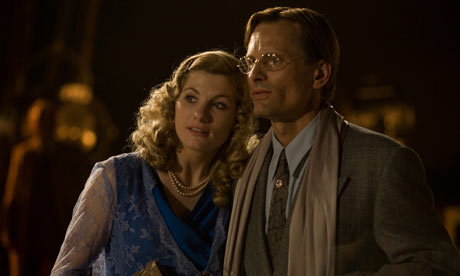
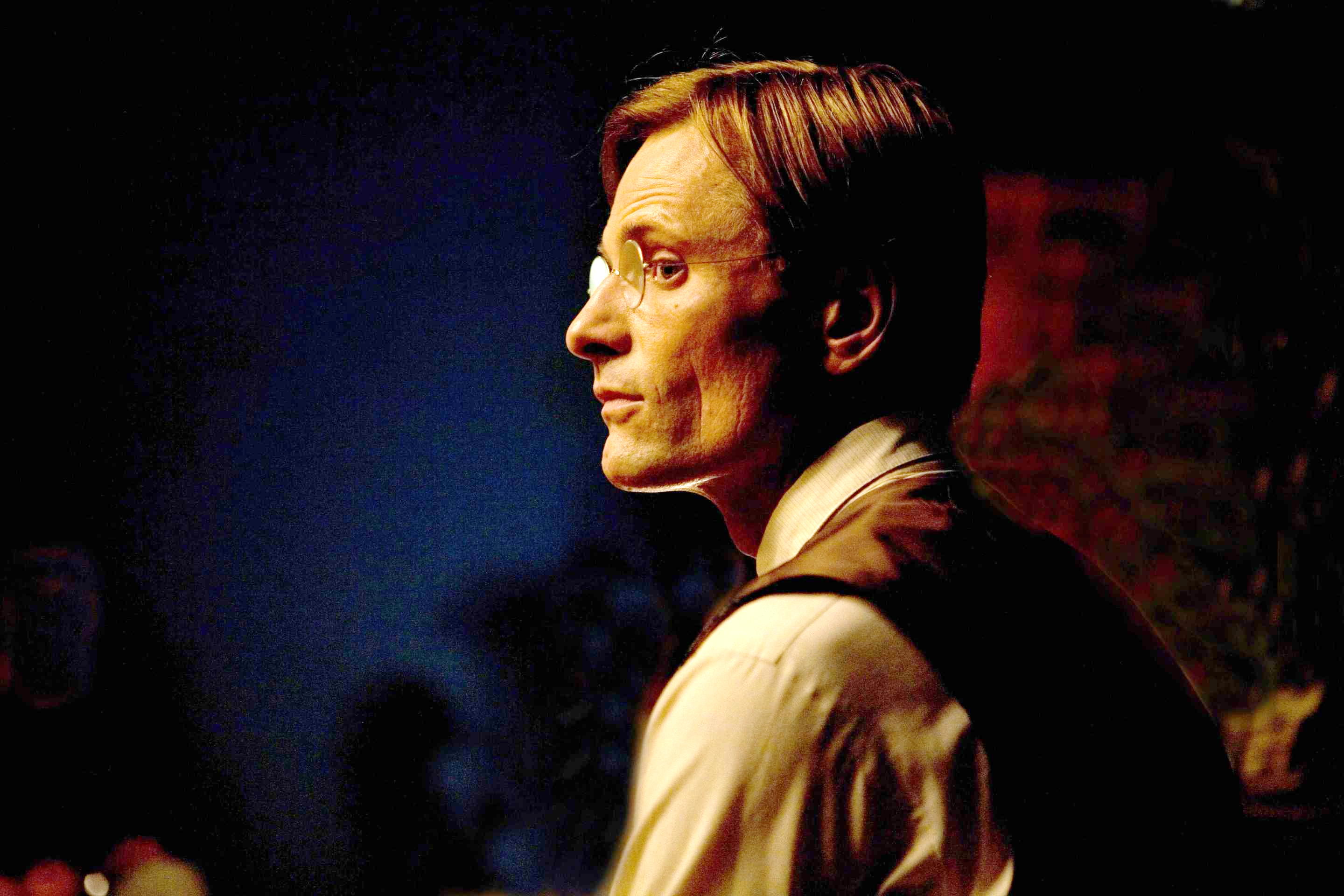
I believe the movie was entitled "Good" because of the main character's (John) struggle to be a good person. He is torn right from the beginning by two women and he wants to be good to each of them, but can only maintain one. In his mind, he may have been doing the right thing, the good thing, but the picture presents an example of when he is no longer viewed as good. John's ex-father in law attends the same party as him and his new wife anna, and his father in law condemns him for his divorce of his daughter. Another example of John's desire to appear good is when his friend asks him to buy him a train ticket to Paris. He is confronted by fellow nazi officers at the train station, and he needs to do the right thing and he is torn by the desire to buy the ticket and the desire to stay in good standing with the Nazi Party. He breaks from this desire to by held high in the party when he goes to the prison camp to look for his friend. John chooses right over wrong in this case friendship over naziism and in the end, although clad in a nazi uniform, tries to overcome evil and do good.
The film was entitled Good because the protagonist of the movie has the idea that he is a good man throughout the movie.In the beginning of the film, he prides himself on his moral values.As the movie progresses, he does not seem to realize that his morals have become skewed since he began working for the S.S.He continues to think that he is not one of the Nazis despite the fact that he has joined the party.He does not fully associate himself with the Nazi Party so he thinks that he still is the same man he was before he joined the party.
The film’s title may also be attributed to the way the meaning of the word “good” is manipulated and changed by the propaganda and ideals put out by the members of the Nazi party.They believe that they are doing the right thing and are contributing to humanity and to Germany.The Nazis also believe that they are above everyone else because of their elite moral and ethical standards; they even go as far as to say that the rules do not apply to them.They continue to push their nationalist, socialist, and anti-Semitic views onto John and he hesitantly buys into it. The more John is around them, the more he becomes like them, and his idea of what is “good” becomes more skewed.
The picture represents a point in the movie where it is apparent that John’s morals have become something other than what they used to be.In the beginning of the movie, he was a loyal and dedicated husband and father who refused to join the Nazi party because of his beliefs and because of his Jewish friend.At this point in the movie he is a high-ranking member of the Party and is married to the woman he had an affair with.He believes that he is still a good man because he did the right thing by his wife and divorced her and made an honest woman out of this lady on the side.In this scene, John is approached by his ex-father-in-law who announces that he fears for the party because of its acceptance of a man with “such moral weakness,” an ironic statement considering the actions of the party.It is shortly after this scene when John is informed that the rules do not apply to him.
The film was most likely not distributed in the United States because it depicts a government that controls the information that reaches its agents and the media, hiding the truth form the majority.The United States government has done this on a few occasions, including the containment of Japanese-Americans after the attack on Pearl Harbor, and the firebombing of Dresden.The United States probably doesn’t want its people to think that their government can easily manipulate them like the Nazi party did to the majority of the German citizens.