The War on Drugs is not winnable on any level. If enough people want to have access to something, there are people willing to provide it for them in order to make a profit, regardless of the legal consequences or legal status of the product. The people who run the drug cartels that smuggle drugs across the American border for distribution only care about the money they will be making from it. An example of this in the movie would be the Mexican Military General Salazar, who was using his position in the military to aid his drug trade. If someone has a strong addiction to a substance, they will do anything it takes to get it. This is especially apparent in the movie Traffic when Caroline runs away from rehab and is sleeping around with drug dealers, most likely in exchange for drugs. She essentially gives up her whole life, friends, family, and school, so that she can lie around and get high all day. Of course in the end, she joins a support group and gets clean, but in reality that doesn’t happen for most people who have serious drug problems. As far as the social level goes, if there are drugs out there, at least some people will try them and most likely influence other to do so as well. There will always be groups of teenagers who experiment with drugs, and drug dealers to push drugs on them. The War on Drugs will most likely never be won.
Tuesday, November 23, 2010
Friday, November 5, 2010
Cassimere; American History X
American History X depicts Neo-Nazism as appealing to young middle class white kids. This is shown throughout the movie, especially in the scene of the basketball game between the black kids and the white kids. In this scene the viewer can see how the group of white supremacists might seem appealing to younger white males.
Derrick, a sort of role model to the group, comes off as brave and heroic after he has won the game and the basketball courts for the white supremacist group. They lift him up on their shoulders while the group of black kids walks off the court. To impressionable youths, Derrick looks like someone to look up to, while the group of black kids comes off as inferior because they lost the game, even though they cheated. Finley stated that the black characters in this movie “are depicted in a stereotypical fashion,” and that they come off as aggressive and child-like. Because they are portrayed this way in the movie, I believe that the intent of the filmmaker was to allow the viewer to see them as Danny or someone his age would see them. They would see them exactly in the way that Derrick and Cam Alexander have told them they are. They would only see characteristics that they have heard time and again from one of Derrick’s rants.
Most of the shots in this scene are from fairly public shots during the game. The scene was in black and white with high key lighting and high contrast between the lighter and darker colors on the screen. The swastika tattooed to Derrick’s chest stood out against his skin. The form was very open and the characters moved around from side to side of the frame. When Derrick and the person on the black team who elbowed him were arguing there were close up shots of both men, most likely to emphasize to the viewer the intensity of the scene.
Saturday, October 9, 2010
Cassimere; Good Night and Good Luck
The use of tight framing, all indoor shots, and black and white photography gives the viewer a sense of anxiety and allows them to identify with the characters. Cinematography aims at making the viewer feel as if they are with the characters in the movie, and in this case, the cinematography causes the viewer to almost experience the same pressure and anxiety that the characters in the movie are experiencing. The makers of Good Night and Good Luck wanted the audience to feel like they were in the same situation as the characters in the movie.
Most of the situations in the movie are very tense, and the tight framing emphasizes this tension. Characters are placed on the edges of the screen and given very little room to move around. This focuses the viewer’s attention to only the person speaking, which, in my opinion, causes the viewer to pay critical attention to what the person is saying. Tight framing also gives the impression that the characters can sense the small amount of space around them, which adds a claustrophobic element to the scene. The use of only indoor shots adds to the claustrophobic element. Outdoor shots offer a sense of relief and openness, which is not found in this movie.
The use of black and white photography gives the movie a vintage look, as if it were made in the same year it is set in. I think it is important that the film was shot in black and white because it adds to the ability of the audience to identify with the characters. It also makes everything a little darker, which I think adds to the anxiety factor of the film as well.
Friday, October 1, 2010
Cassimere; Ingourious Basterds
movie theatre. She was able to stay under the Nazi radar because she was smart and kept a low profile. Shosanna knows what she has to do in order to survive and is able to keep her cool in heated situations, even when she comes face to face with the man responsible for the death of her family. She is the only one in the movie to successfully get rid of the Nazi high command without being found out. She is a strong female character who is brave and ambitious, and rightfully takes revenge on those responsible for the wrongs done to her.
Shosanna’s character is best displayed in two particular scenes: the scene where she is “invited” to lunch with Frederic Zoller and the following scene when she is talking to Landa about the premier of Nation’s Pride being moved to her theatre. Both of these scenes display Shosanna’s ability to appear calm and collected, even when she is scared.
The scene where Shosanna meets up with Frederic Zoller at the restaurant has natural lighting and light dark colors. It is obvious that she feels uncomfortable in this situation and this feeling is emphasized by the frame and camera proxemics. The frame is tight when the whole group is included in the shot, leaving Shosanna on the edge of the screen. When she speaks, the camera focuses only on her and leaves everyone else out of the shot, emphasizing that she is not one of them. When Col. Landa enters, the camera moves to Shosanna’s face, and then slowly up to Landa, as if it was parallel to where she was looking. Since Landa’s face is left out of the shot until Shosanna looks at it, the audience feels as though they are anxiously looking up to meet his gaze along with her. When she is talking to Landa alone, only her face is in the shot and she has very little room to move around in the frame. Once he leaves, the camera slightly moves over, allowing her more space, as she finally begins to breathe.
Friday, September 24, 2010
Cassimere Jeremiad
When the Founding Fathers were writing the Bill of Rights, the first thing they wanted to ensure was that all Americans would have the right to practice their religion of choice in peace. However, recently in New York, there have been hundreds of Americans protesting the construction of the "Ground Zero Mosque" (which is actually an Islamic community center, and about five blocks away from Ground Zero). Americans seem to be ignoring the very principals this country was founded upon. Therefore, a jeremiad I would write for today’s Americans would warn them of the dangers of unequal sharing of constitutional rights. If we start picking and choosing which groups of people are allowed to have these rights, then we become the country that our forefathers never wanted us to become.
Part of the problem, I believe, is the fact that most Americans think that all Muslims are terrorists who want to kill us all. Most of them just want to live their lives in peace without feeling as if they are being discriminated against. Americans just need to suck it up and admit that there is no real reason that the Islamic community center should not be built. They may not like the idea of an Islamic center so close to the site of the World Trade Center, but that’s just tough. Muslims are citizens too and they deserve the same rights as everyone else, and if we deny them these rights, then we become the tyrants our forefathers were escaping when they founded this country.
Friday, September 17, 2010
Cassimere Good
The film was entitled Good because the protagonist of the movie has the idea that he is a good man throughout the movie. In the beginning of the film, he prides himself on his moral values. As the movie progresses, he does not seem to realize that his morals have become skewed since he began working for the S.S. He continues to think that he is not one of the Nazis despite the fact that he has joined the party. He does not fully associate himself with the Nazi Party so he thinks that he still is the same man he was before he joined the party.
The film’s title may also be attributed to the way the meaning of the word “good” is manipulated and changed by the propaganda and ideals put out by the members of the Nazi party. They believe that they are doing the right thing and are contributing to humanity and to Germany. The Nazis also believe that they are above everyone else because of their elite moral and ethical standards; they even go as far as to say that the rules do not apply to them. They continue to push their nationalist, socialist, and anti-Semitic views onto John and he hesitantly buys into it. The more John is around them, the more he becomes like them, and his idea of what is “good” becomes more skewed.
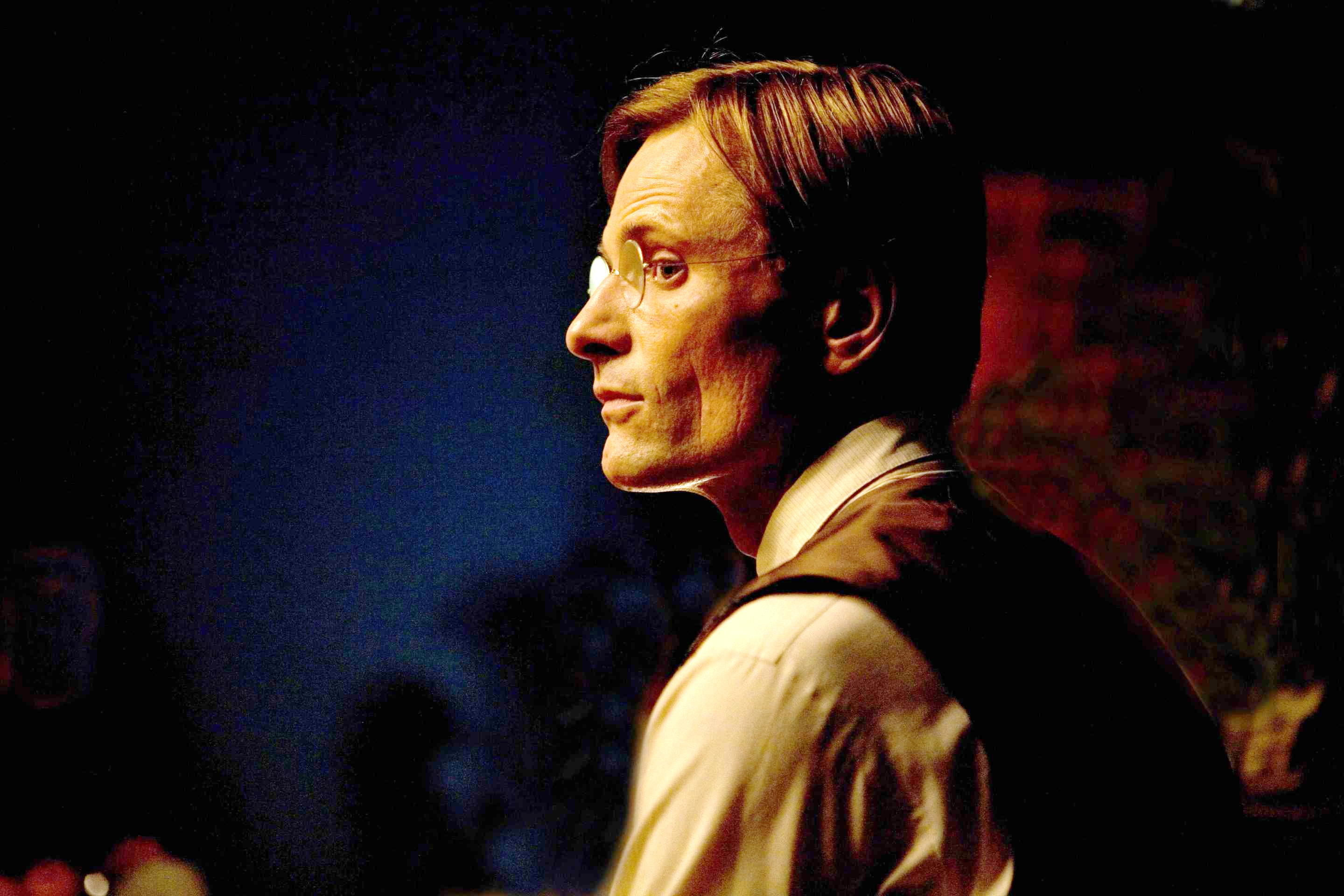
The picture represents a point in the movie where it is apparent that John’s morals have become something other than what they used to be. In the beginning of the movie, he was a loyal and dedicated husband and father who refused to join the Nazi party because of his beliefs and because of his Jewish friend. At this point in the movie he is a high-ranking member of the Party and is married to the woman he had an affair with. He believes that he is still a good man because he did the right thing by his wife and divorced her and made an honest woman out of this lady on the side. In this scene, John is approached by his ex-father-in-law who announces that he fears for the party because of its acceptance of a man with “such moral weakness,” an ironic statement considering the actions of the party. It is shortly after this scene when John is informed that the rules do not apply to him.
The film was most likely not distributed in the United States because it depicts a government that controls the information that reaches its agents and the media, hiding the truth form the majority. The United States government has done this on a few occasions, including the containment of Japanese-Americans after the attack on Pearl Harbor, and the firebombing of Dresden. The United States probably doesn’t want its people to think that their government can easily manipulate them like the Nazi party did to the majority of the German citizens.
Friday, September 10, 2010
Cassimere W.
In the movie W., director Oliver Stone tires to let the viewer see who George W. Bush really is. When I think about the movie and the specific scenes when the character of Bush is brought into focus, I think of two scenes in particular. The first one that comes to mind is the scene when the young Bush is drinking in a bar with his current girlfriend, Fran. As they are sitting at the bar, he starts talking idealistically about the future he plans on having with her. It is obvious that he isn’t completely serious about the matter, even though he may think he is. From this scene, the viewer can tell that Bush doesn’t always think realistically. The viewer can also tell that he is slightly impulsive and does not always thoroughly think things through before making decisions. He goes on rambling about how happy she makes him and how he wants her to be a part of his family. It comes off as the kind of thing a drunk man would say to a girl, but she takes it seriously and Bush ends up proposing to her. The viewer can tell that when he started talking he did not have the intention of proposing to her, it just kind of happened.
In the next scene, Bush goes to his father’s office to have a talk with him. You can tell at once that he is uncomfortable with the situation and is not looking forward to talking to his father by the expression on his face. The viewer gets the impression that his father intimidates him. George H. W. Bush then proceeds to reprimand “Junior” for not sticking with any of the jobs he sets him up with, telling him to get his act together, and comparing him to his brother, Jeb. For the most part of this conversation, W. is nervously pacing across he floor with his hands on his head looking exasperated and insulted. He knows how his father feels and is convinced that he has no way of changing it. Bush struggles with this throughout the movie, but in this particular scene, the viewer can clearly tell that Bush wants to make his father proud, but just does not know how. As Bush is exiting the room, his father tells him that he “deeply disappoint[s]” him. W has no response to this, he just leaves, but it is apparent that he resents his father a little for it.
Friday, September 3, 2010
Cassimere West Wing
In the pilot episode of The West Wing, the White House staff is faced with a few political issues, including an out of line comment made by Josh, the Deputy Chief of Staff, to a representative of a religious political group. The comment was made as a joke but was nonetheless insulting to the religious right. The President took the incident very seriously and was considering firing Josh over it. This was probably the most pressing political issue the President had to deal with in the episode.
Most Americans assume that views expressed by individual members of the White House staff are views that are shared among all of them. This is probably why the comment Josh made was such a huge controversy. If the White House administration lost the support of the religious right, it could affect the nation’s view of the administration, which could in turn affect the President’s approval rating.
The controversy also brings up the issue of separation of church and state. The religious right is pushing the White House administration to comply with “Christian family values.” Even though the government has no obligation to do so, they are still forced to cooperate with the members of the religious political group in order to avoid public relations issues. In the last scene of the episode, Josh, Toby, and CJ have a meeting with Mary Marsh and the Reverend in order to try to correct Josh’s public faux pas. Mary Marsh and her group make it clear that they have no regard for separation of church and state especially when one of them asks why there is so much talk of the first amendment and none of the first commandment. The meeting then turns into a heated argument and is over before any decisions are made, and accomplishes nothing in the end.