Friday, November 19, 2010
Farris - Traffic
Wednesday, November 10, 2010
Farris - State of Play
Large corporations have the ability to undermine democracy as a whole because of their ability to sway the opinions of large groups of people for personal gain. Corporations are given the ability to act as "individuals," when clearly there are a lot of people behind any given company. With these large numbers, and large amounts of money, corporations can basically control all major political decisions made in this country that reflect their own self interest.
Thursday, November 4, 2010
Farris American History X
Neo-Nazism is depicted throughout American History X as a means of self-identification for lower-class white groups who feel victimized as if their own personal freedoms are being limited because of the influx of minority groups into any given area, as suggested by Finley's article. In the movie, it is also suggested that broken family structures can also lead to becoming involved with such a group, because younger members searching for the ideal "family" feel comforted in this group atmosphere. The scene in American History X that best illustrates how a person from a "broken family" would be attracted to Neo-Nazism is the dinner scene in which Derek and Danny's mother invites her new boyfriend over for the first time. A political discussion ensues, which becomes extremely heated in a matter of seconds. Derek is hostile towards this man because he feels as if he is trying to replace his father. Derek's entire goal while arguing was to violently combat everything that this man suggested no matter what, in order to intimidate him. The color values used in this scene play an extremely important part. The scene is in black and white, which actually causes the viewer to focus on the violence without worrying about other details. The intimate camera proxemics and tight framing used around each character in the scene cause audiences to look deep into the character's minds to examine what they are really thinking.
Thursday, October 7, 2010
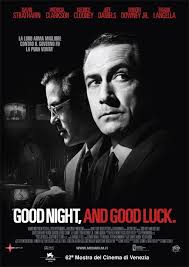
Farris - Good Night and Good Luck
On the surface, Good Night and Good Luck is about the Red Scare prevalent in the United States in the 1950s in which Americans lived in constant fear of the infiltration of the government by Communists. But, since this film was released in the early 2000s, it can be said that the underlying message of the movie is actually about the “terrorist scare” that was witnessed in the U.S. after the 9/11 attacks in 2001, and is still very much felt to this day.
Senator Joseph McCarthy’s televised proclamations about known communists in the government and in Hollywood did what they were meant to do: instill fear into the American public. These claims, however, were not exactly justified because there was no real proof to back them up, but they were still widely believed anyway. Similarly, President George W. Bush and members of his cabinet made public claims about the confirmed existence of weapons of mass destruction in the Middle East, which also lacked in proof to back them up.
A country in fear is extremely gullible, and is even willing to give up certain freedoms in order to feel safe. In the 1950s, phone taps were widely used to track down “Commies.” After 9/11 the Patriot Act was passed, allowing the government to have access to people’s emails, phone conversations, and other records. Whether these methods are effective are debatable.
Yes, I do think that Edward R. Murrow would have been as successful today as he was in the 1950s, although he would need have used a few different methods. People today simply do not watch television as diligently as they did in the past because there are so many other forms of entertainment available, especially via the internet. In order to be heard, Murrow would need to adapt his message to these technologies.
Friday, October 1, 2010
Farris - Inglourious Basterds
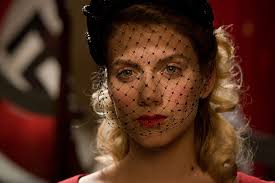
Shoshanna, who is referred to under the pseudonym "Emanuelle" for most of the movie, is a very visually striking character. This photo I have chosen really sums up her entire persona. The tight frame, closed form, and personal camera proxemics used here cause the audience to look deep into her character in an intimate setting. The dominant in this image is her eyes, which are highlighted by high-key lighting. Her eyes appear to be in a daze, suggesting that she is deep in thought about her murder plot. The subsidiary contrast is the the Nazi flag, but since it is unfocused while Shoshanna is in focus, it can be assumed that she will overpower the Nazi regime. The dominant color used is red, foreshadowing the blood that will be shed in her theater by her own accord in the grand finale of this movie.
In my opinion, Shoshanna is by far the most significant character in Inglourious Basterds, because of her fierce, powerful personality. She has experienced terrible injustices in her life, which only made her stronger. Furthermore, she is able to portray herself as a simple cinema owner, when she is actually the mastermind behind the greatest (fictional) murder plot in history.
Wednesday, September 15, 2010
Farris: Good

The title “Good” is appropriate for this movie because it portrays the story of one good-hearted man who becomes unintentionally wrapped up with Nazi happenings. It proves the point that good people are often steered in the wrong direction, in this case due to the fear of what the consequences would have been for speaking out openly against the Nazi regime. Professor John Halder, as portrayed by Viggo Mortensen, always put others before himself: he looks after his dimensia-stricken mother, and sticks by an eccentric, uninterested wife for the sake of his children. Halder’s book about euthanasia is made into a propaganda film by the Nazi Party promoting the eugenics program, which earns him an honorary Nazi title that he doesn’t take too seriously at first. His best friend Maurice, a Jewish psychiatrist, warns him about becoming involved with such tyrants, to which Halder disregards by saying, “They like to have a few academics around to give them the veneer of sophistication.” This opinion soon changes though, as Halder becomes power hungry and rises up in the Nazi world; he even begins wearing a Nazi uniform. Becoming associated with the Party is the first of many small decisions that Halder makes that leads to the devastating finale of the movie in which he sees an emaciated Maurice in a concentration camp.
This movie’s goal is to make people think about how they would react when put in such a situation: when what you know is right is against the popular belief of an entire nation.
The image presented is important because it suggests a message about people not truly being who they appear. This is done through the use of contrasting color values. John Halder is dressed in black, a color of evil, although we learn throughout the movie that deep down he was “good” person, and didn’t intend to become affiliated with Hitler’s regime. Anne Hartmann on the other hand is dressed in white, a color of pureness and innocence, when really she is an evil Nazi sympathizer.
The reason I think this film wasn’t released in the US is because of it’s unique message about not all Nazis being downright evil. I don’t think this idea would sit well with American audiences, who prefer to view Nazis in a much more devilish light.
Tuesday, September 7, 2010
Farris - W

In the movie W, George W. Bush, as played by actor Josh Brolin, is portrayed as a very simple minded man whose only goal in life is to impress his father. The scene in the movie that seems to sum up his entire character is the scene in which Bush Jr. is being initiated into the Delta Kappa fraternity. The lead frat member who is organizing the hazing activities asks the initiates to name members already in the fraternity, and Bush Jr. is the only one who knows their names, as well as their nicknames. It is then revealed that his father was once an “Delta Kappster” himself, making Bush Jr. a legacy and all the more desirable. This really sets the stage for the entire movie, showing that Bush Jr. cannot get anywhere in life without the assistance of his father’s connections. Bush Sr. has to bail his son out of jail, as well as pull strings to get him into college, proving that Bush Jr. is helpless and weak. This idea of helplessness is further emphasized throughout the movie. Bush Jr. cannot seem to make any political decisions for himself, and allows himself to be influenced heavily by Dick Cheney and Karl Rove. The entire movie basically revolves around Bush Jr. trying to earn the approval of his father and prove to be a better president than he was, which he fails at when the invasion of Iraq, which his entire presidency revolved around, turned up empty handed.
As far as mise-en-scene goes, the entire fraternity initiation scene takes place in almost darkness. This darkness represents the evil and corruptness of the members of the fraternity, who admit in the scene that their families rule the world because of money and connections.