Thursday, October 7, 2010
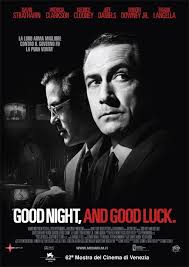
McElvaine. Good Night and Good Luck.

Vucic Bastards
The most interesting character in the movie Inglorious Bastards is by far Christoph Waltz who plays the role of Hans Landa, a high ranking official of the Nazi party bent on finding jews in hiding . First and foremost, I have chosen Waltz as my favorite because of his stunning performance on screen. His character stood out most because it was so believable. Brad Pitt's character was well done as well but when I saw him on screen, I knew I was looking at Pitt rather then Aldo Raine. Waltz's character allows you to really get into the movie and start hating this guy. This guy is the most ingenious character in the whole movie. Waltz will talk to you in front of your face and win you with his charm in a matter of seconds, then the next thing you know he will turn it all around on you and be on the floor strangling you to death. Waltz is easily the most compelling character in the entire film and stays that way throughout. Furthermore, Waltz steals the scene of every scene he is in. Pitt is supposed to be the major character in the film but every frame that Waltz appears in has your attention immediately directed towards him. Rather, he demands your attention because he so wonderfully pulls off the sly and cunning character traits that are required for this role. Waltz is one of those characters that we love to hate and leaves a lasting impression on us well after the movie is over.
Farris - Good Night and Good Luck
On the surface, Good Night and Good Luck is about the Red Scare prevalent in the United States in the 1950s in which Americans lived in constant fear of the infiltration of the government by Communists. But, since this film was released in the early 2000s, it can be said that the underlying message of the movie is actually about the “terrorist scare” that was witnessed in the U.S. after the 9/11 attacks in 2001, and is still very much felt to this day.
Senator Joseph McCarthy’s televised proclamations about known communists in the government and in Hollywood did what they were meant to do: instill fear into the American public. These claims, however, were not exactly justified because there was no real proof to back them up, but they were still widely believed anyway. Similarly, President George W. Bush and members of his cabinet made public claims about the confirmed existence of weapons of mass destruction in the Middle East, which also lacked in proof to back them up.
A country in fear is extremely gullible, and is even willing to give up certain freedoms in order to feel safe. In the 1950s, phone taps were widely used to track down “Commies.” After 9/11 the Patriot Act was passed, allowing the government to have access to people’s emails, phone conversations, and other records. Whether these methods are effective are debatable.
Yes, I do think that Edward R. Murrow would have been as successful today as he was in the 1950s, although he would need have used a few different methods. People today simply do not watch television as diligently as they did in the past because there are so many other forms of entertainment available, especially via the internet. In order to be heard, Murrow would need to adapt his message to these technologies.
Oria, Inglorious Bastards
My favorite character from the movie is Shoshanna. She goes through so much throughout the entire movie and I feel like she has the most reason to burn down the theater with the Nazis in it. Now it is not that the others did not have a reason to kill the Nazis, I mean who did not want to kill the Nazis, but I feel like Shoshanna has such a deeply rooted hatred for them because of what they did to her family. She is such a strong character and that is why I think I like her as much as I do. She sacrifices her life, her theater, and the love of her life Marcel all to seek revenge for the massacre of her family and her people. The entire movie I feel like she is very strong and intense. Whenever Shoshanna is shown, she is working on the cinema. The scene that made her my favorite character was the one where she was getting prepared for the Nazi night in her cinema. She is dressed in a floor length bright, red dress. This is the brightest outfit she wears the entire movie, all of the other ones were very plain and dull colors. I think that this was done because red symbolizes anger, passion, or blood. She is angry with the Nazis and is passionate about killing them. I do not know if this is true or not but I remember hearing in a movie once that if a person was some how involved with the death of a person, at their funeral they wear red. This might not be true but if it is then I found it interesting that she was in red because she is going to be the cause of a lot of Nazi deaths in that theater.
The picture I choose I felt truly describes her; it is when she is about to go see the Nazis. If you look at the lighting, it is lighter around her eyes and that is what I was first drawn to, it was the dominant image. Her eyes are very intense and determined but at the same time they are slightly covered by the black veil. I think that this represents how she knows what she has to do and she is going to do it but at the same time she is not going to reveal it to everyone. Also I think that it is significant that it is not solid piece of fabric over her eyes that completely cover them because it is not like she has tried to hide her distaste towards Frederick Zuller, he just has not gotten the message. The next thing my eyes are drawn to is the swastika in the background. It is kind of blurred but it can still be made out. It is huge but I am not drawn to it at first because it kind it just kind of falls into the background which I believe means that it was all over the place in this time and it was not uncommon to see them everywhere. It could also represent her motivation for burning down the building. It looks like it is apart of the building and she wants to destroy everything that is Nazi. Therefore she must destroy the building because the Nazis are in the building.
del Valle, Good Night, and Good Luck
“His primary achievement has been in confusing the public mind, as between internal and the external threats of Communism. We must not confuse dissent (opposition) with disloyalty. We must remember always that accusation is not proof and that conviction depends upon evidence and due process of law. We will not walk in fear, one of another. We will not be driven by fear into an age of unreason, if we dig deep in our history and our doctrine, and remember that we are not descended from fearful men -- not from men who feared to write, to speak, to associate and to defend causes that were, for the moment, unpopular." (“Of Murrow, McCarthy & Miller” by Jim Emerson)
In the film, Good Night, and Good Luck, there are many uncertainties surrounding Joseph McCarthy and his approach towards “ridding the country of communism”, that are pointed out in newscasts by the reporter Edward R. Murrow. Joseph McCarthy attempted to gain the support of the country through propaganda, “half-truths”, and some “outright lies”. For example, he had claimed that the American Civil Liberties Union was reported as a Communist Party in disguise, however he was never able to state who had reported the group as this, in fact, there was evidence proving this group as the opposite, as a group known to never have been reported as dissident. McCarthy used lies to not only persuade the country, but to also confuse them into consent, convincing them that those being prosecuted were threats to the country in their loyalty to communism and disloyalty to America. He also had a way of confusing disloyalty with disagreement. He seemed to forget that in our country that all people are innocent until proven guilty. Similarly, in 2005, there was skepticism revolving the Bush and Cheney administration and their choice to begin a war with Iraq. The basis of their choice was evidence they claimed to have that proved that there were Weapons of Mass Destruction being made in the country. However, similar to the way McCarthy’s accusations were always just that, and not based on actual facts or evidence, but instead based more in falsehoods, the “discovery” of the weapons, also, was just an accusation, and when further investigated was in fact proven to be false. However, the government continued on their track, insisting the evidence, which had been falsified, still gave reason to start the invasions and wars. McCarthy’s accusations has more evidence opposing his beliefs, however he carried on with his persecutions, similarly the administration in 2005, did the same. When Cheney received documents from the British, from the Italiams, claiming to confirm Iraq’s purchase of uranium of Niger, the CIA was notified and called for a further investigation of the situation, when the investigation was complete, it was verified that the documents were forged, however, the administration still referred to these documents as a form of validation or as a motive for their actions.
Considering the similarity of the two situations, I think Edward R. Murrow would be successful had he taken the same approach in 2005 that he did in 1953. I don’t think it would happen right away, however, I think, through a few steps, he would gain the support of the country. Through presenting the public with the facts, based on evidence, that would prove the government was lying, he would raise doubts in the public, and therefore make them question the administration. Then through his persistence in presenting these truths, he would eventually persuade, some, and possibly all of the public, to see the truth. Finally, he would gain their full support when pointing out things such as how the government is hurting the public in their decisions, creating a “common enemy”, and then by pointing out that our country was based on the idea that everyone is innocent until proven guilty, and without proper evidence supporting otherwise, those being attacked are not guilty.
Wednesday, October 6, 2010
Woodall Good Night, and Good Luck
Although I believe the plot and overall structure of Good Night, and Good Luck was slightly anti-climatic and left more to be desired, the cinematic techniques boosted the film tremendously. First, director George Clooney’s choice to shoot in black and white sets the period and really proves just how much actor David Strathairn resembles Edward R. Murrow. It also symbolizes the clear division between the two factions: Murrow’s team and McCarthy.
The black and white also exaggerates the high contrast lighting used throughout the film. The bright whites mixed with the brooding dark shadows induce a sense of uneasiness and tenseness, which was how Murrow and the nation as a whole felt during the McCarthy trials, and how I felt watching. Black and white film heightens this stark contrast; color would only blend together and deemphasize the contrasting light and dark.
Finally, the use of close up shots throughout the movie brings the audience in and makes us feel a part of the action, not just spectators. We are able to see the expressions of the characters in detail as react to different events. We are able to see Don Hollenbeck unsuccessfully hide his anguish as he listens to the poor review of his show; we see Murrow’s determination when he is fighting for the initial chance to confront McCarthy; and we see Murrow’s subtle satisfaction after the end of every show. These close ups give us an opportunity to really feel what the characters are feeling instead of having to told through dialogue or other techniques.
With all its short-comings, the cinematic techniques Clooney employs bring Good Night, and Good Luck into the upper echelons of film.
Oria, Jeremiad
The biggest issue that I believe needs to be addressed in American society today would have to be discrimination towards others. Many people believe that discrimination and segregation ended when African Americans gained their freedom and rights, but in reality it still exists today. Discrimination can be seen everywhere across the United States, but it is particularly evident with men and women who are Muslim or just of Middle-Eastern decent. People have a hard time accepting what is different from them. Muslims are feared because of the events that took place on 9/11, but is it right to label an entire race just because the actions of a group? What I am trying to say is that all because the terrorist who crashed the planes on 9/11 were Muslim extremists, does not mean that every Muslim you meet shares the same morals or sentiments. Although this generalization should not happen, it still does. As a result, today’s society has developed an “Islamophobia,” they fear Muslims and believe that if they are allowed to practice their religion freely in America, then we are allowing terrorists to have a free for all. There was an incident in Houston, Texas involving a Middle-Eastern man who was shot and wounded by another man. When asked why he shot the Middle-Eastern man, the assailant accused the man of “blowing up the country.” Another story tells of four immigrants who were shot and killed by a man as revenge for 9/11. This country is becoming increasingly discriminative towards Muslims and people who look Middle-Eastern. It needs to end because everyone is equal, no matter what he or she looks like or what he or she believes in. A good majority of the Muslims that occupy America are citizens and have lived here their entire lives. They have just as much of a right to the first amendment as any one else who lives here. If this discrimination does not end, we are going to revert to how it was when African Americans were segregated.