Saturday, October 9, 2010

Rivera: Good Luck America


The film is based on Edward Murrow's public attempts to reveal McCarthy's completely ridiculous witch hunt for what it truly was. It wasn't a ploy to reveal potential communists within the US government, but a ploy to shine light on his career. The film was made at an important time in modern US history, the reelection of bush just occurred, and the war in the middle east is still underway, and maybe most importantly, there still has been no discovery of WMD's in the Middle East. The similarities between the film and the events occurring 2005 are clear; should we stand by and accept what our government tells us? As Murrow said, “Our history will be what we make of it”.
“The war on terror” has received plenty of controversy, and very little praise, sense the events of 9/11. It seems as though our government is constantly issuing statements, only later to retract or change them to correct errors. All the while expecting the American people to stand by and mindlessly accept any information given as proof. Murrow's statements then, are just as important to us now, for the issue he was speaking of remains never-ending; no matter how afraid we are, no matter how severe the punishment, the most important thing we can do as people is to always stand up for what is right. The government says there are WMD's in Iraq? Prove it. McCarthy says he knows there are communist ties in our government? Where was his proof? Murrow shows there is no wrong in deciding your government can be wrong. “We must not confuse dissent with disloyalty. When the loyal opposition dies, I think the soul of America dies with it.” He is saying do not lose ourselves, not just as individuals, but as a nation. By standing by and letting our government lie to us, to bring terror into our hearts and offer no proof is simply unacceptable. Today, with war still in the Middle East, it is hard to say if Murrow would be heard by Americans. The events of the 1953 Red Scare were so easy to continue because the government was able to instil fear into Americans by creating an enemy, Stalin, Socialist governments. The government said they were going to protect us from the evils of Stalin, so we allowed them to feed us, we accepted their safety without question. In 2005, Americans believed they had a clear idea of who the enemy was, there was no need for the government to paint us a picture. Yet, they did. They told us “these people over here are enemies, and so are these people, they have these weapons and they want to hurt us”. Well again, Americans wanted to feels safe, safer than after 9/11. See, the events of 9/11 changed America, maybe shook us back in time even. It brought us back to a time when we were afraid, and all we wanted was safety. Our government was the source of that safety. America had been pushed back to the state that Murrow had warned us about, just like in 1953. Edward Murrow was a very persistent man in '53, and he would be just as persistent today. He would not accept conviction without evidence then and would not do it today. It's hard to say if he would be heard by American people today however. I mean, he said it then, so why did we stop listening?

Armentor Goodnight Sweet Prince


While the arena of Goodnight and Goodluck highlighted a major socio-political contraversey in our young history, the ideas in question, at least under the lens of a broadcasting station, are still as relevant today as they were in the 1950's. Although I feel some view this overall conflict as a fued between two men, McCarthy and Murrow, the film Goodnight and Goodluck serves not only as a political commentary on Habeas Corpus (highlighted by Eisenhower's speech at the end), but as an insight into the interworkings of a broadcasting station. The station encounters problems such as censorship, advertising disputes, and accusations of bias. Now if I were to ask Anderson Cooper if he encounters all three of these issues on a daily basis, would anyone think he would tell me no? One hears all the time of the apparent monopoly left wing politics has on Television, with syndecates such as MSNBC, CBS, and CNN holding more cards then poor little Fox News. It was interesting to see the backroom crafting of the news, how a story presented as objective really goes under intense scrutiny and editing before its presented as a 30 minute "product" for visual consumers. This sense of "inventing the news" is not only still practiced but has maybe even intensified; for example I can recall a few months back when the Sean Hannity show ran a clip in the fall depicting imagery from a protest in the spring (the trees gave it away) that was a blatant example of news fabrication.

About the only thing that has changed in this whole process is the scale and the audience. In the time of Ed Murrow, the variety of television was severely limited, making Ed Murrow's face a more widely recgonized face then that of Katie Kourac. But now, everythings bigger, the audience, the channels, the news stations...now there are specialized programming for different political slants, is not Rachel Maddow set up to serve a particular interest? But also, the whole idea of media has now changed. Whereas in 1950 when THE media was two television stations and newspapers, now with the internet, an intense new media culture has blossomed. With the spread of media has come accessibility and today everyone has access to all forms of news, allowing people to edit the news for themselves.

Calderon Good Night and Good Luck

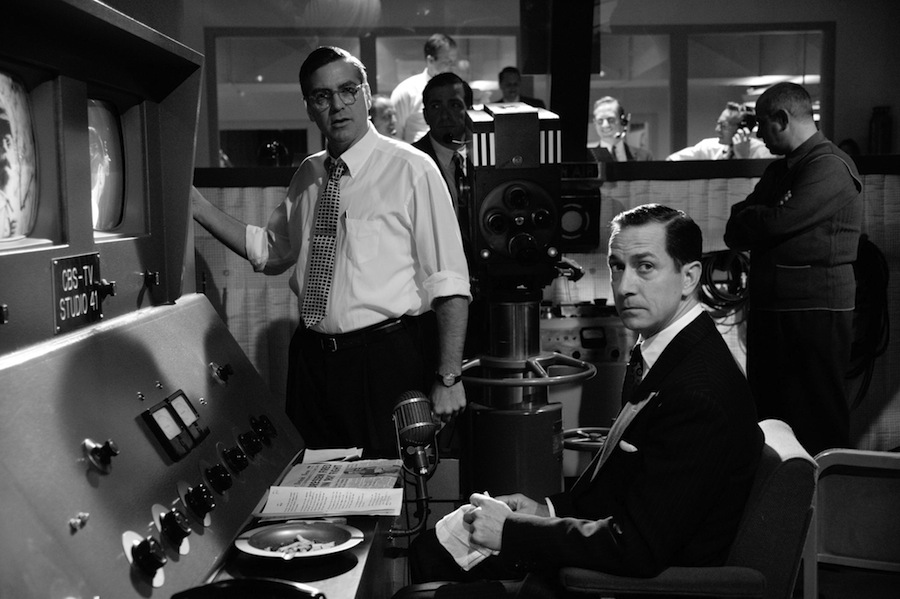
Black and white photography sets a completely different mode for the movie. It mainly focuses on a speech from Edward Murrow, but the black and white photography captures the audience into the era. George Clooney wanted to set the stage for the feel of the 1950s. The black ties and crisp white shirts with smoke in the background are a meticulous example. The inside shots also very clearly reveal how people in the 50s worked in offices. Every scene is inside and in the studio. It really shows the seriousness about work and how much work was put into the show. The tightness and extreme close-ups, especially on Edward Murrow, show the seriousness again & focus solely on Edward Murrow. He was the leader and he stood up against McCarthy, so he had to be the sole focus. The picture posted here again demonstrates the closeness of the team working in the studios. The shot is medium closeness so it is not completely focused on one person. They were a team, so it shows how they always worked together. Altogether, the cinematography of black and white gives the movie a sort of history feel to it. It seems as though it is a history movie with the black and white, but it is perfect in black and white. It would definitely not have the same feel if the movie were in color.

Lighter - Authentic 1950's


George Clooney’s movie Good Night and Good Luck uses a authentic 1950’s feel by using black and white, close ups, and only indoor shots. Clooney originally shot this movie in color and later switched it to black and white. The black and white effect is a realistic attribute to this film because in the 1950’s all film was in black in white. The choice to do this was very influential to how the viewers experienced the film, it gives the viewers authentic feel and it blends well with real footage from the 1950’s. The dramatic close ups were also an important part of the viewing experience; they added a stressful or intense feeling to the film. The viewers can feel “closer” to the film with these close ups because of the feeling it makes someone feel as the camera slowly moves closer to the speakers face. Finally, the indoor shots are another authentic part of the film. This time period is the beginning of television, which also means they are using the first video cameras. A trend in technology is that everything when it first comes out is quite large and was not easily moved, which is why there are no outdoor shots, because the transportation was simply not easy. Overall, the general feeling all this effects has on a viewers is a very authentic 1950’s feel with a intensity that keeps you on the edge of your seat waiting for what will happen next. I enjoyed the film because of the authenticity and because of the differences from other films made in 2005. I find this film to be more interesting because of how authentic it is, if it was in color the feel of the movie would be unnatural and would not be as enjoyable.

Bone GNGL


The three cinematic techniques that really influenced how I
felt about Goodnight and Good luck were the indoor shots,
close ups, and tight frames. All of these different aspects
really show how the people's minds of this time period were
like. Everyone kept close tabs on everyone else this is displayed in the
tight frames. The close shots reminds people that they were
always being watched. Everyone is very paranoid in this movie. The couple that worked together hid their relationship from their fellow employees. They did this so they could keep their jobs. We see them in tight frames, and this describes the relationship between two people who are married. They cannot express their love but we witness it in the close ups. The people in the movie are afraid to bad mouth McCarthy because of the paranoid attitude symptomatic of the era, during which the blacklisting of notable figures who expressed views of dissension was commonplace.
Edward R. Murrow was filmed in a close tight frame. During these slow moving zoomed-in shots we as viewers feel he is talking to us directly. The time period made it so that with the limited people on television that people felt a personal relationship with the people who were broadcasted into their homes. The statements Murrow made influenced many people because of this personal relationship the viewers felt.

The indoor shots made me realize how suffocating the people felt. There was no room for anyone to made a mistake or say something that made them sound communist. The characters never got any fresh air or relief.

Cassimere; Good Night and Good Luck


The use of tight framing, all indoor shots, and black and white photography gives the viewer a sense of anxiety and allows them to identify with the characters. Cinematography aims at making the viewer feel as if they are with the characters in the movie, and in this case, the cinematography causes the viewer to almost experience the same pressure and anxiety that the characters in the movie are experiencing. The makers of Good Night and Good Luck wanted the audience to feel like they were in the same situation as the characters in the movie.

Most of the situations in the movie are very tense, and the tight framing emphasizes this tension. Characters are placed on the edges of the screen and given very little room to move around. This focuses the viewer’s attention to only the person speaking, which, in my opinion, causes the viewer to pay critical attention to what the person is saying. Tight framing also gives the impression that the characters can sense the small amount of space around them, which adds a claustrophobic element to the scene. The use of only indoor shots adds to the claustrophobic element. Outdoor shots offer a sense of relief and openness, which is not found in this movie.

The use of black and white photography gives the movie a vintage look, as if it were made in the same year it is set in. I think it is important that the film was shot in black and white because it adds to the ability of the audience to identify with the characters. It also makes everything a little darker, which I think adds to the anxiety factor of the film as well.

McGowan GNGL

Good Night And Good Luck is

a film that portrayed the red scare in 1953. This film did a great job of showing the nature of the decade. For example, it was shot in black and white. This is the most obvious element that influences perception of this film. Although it was filmed in 2005, viewers feel as though they are watching a classic. I think this is one of the most important elements of the film. The black and white of the film made me perceive it as if it was actually shot in the 1950's.

Another element that I noticed was the high contrast lighting. It was a lot of black and white and not a lot of grey. This harsh lighting showed the material as being very harsh, as this was a harsh time for America. It is almost as if you are in the middle of a horror film because everyone is frightened. I think that this painted an excellent picture of the nature of the red scare in the 1950's.

The last element that I would like to discuss would have to be the many slow close ups of the film. I think it is very interesting that the camera goes from a very formal distance to an up close and personal distance. This made me perceive the film as being very intense. I honestly had a hard time watching this film because it made me feel the tension in the scenes.