Showing posts with label scene. Show all posts

Thursday, September 16, 2010

Calderon Good


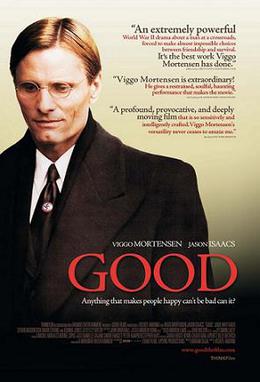
Good impressed me tremendously with the great story and an ending that could not have been stranger. Essentially, Good deals with the main character, Halder, struggling because he is such a good man to his wife, family, students, and friends that people seem to think less of him. He is what society would call a “good” man. He works hard for what he wants and does not want to let anyone down. Notice his wife rarely shows up in the movie because he is always doing the work. He cooks, cleans, and works hard for the family. He is trying so hard to be the best husband, father, professor, and son that he can be. The title hints throughout the movie that good is what he wants to be, but his decisions ultimately lead to his demise. He wants to be this good person like the title says, but he puts so much effort into it that it was just easier to join the Nazi Party. It was most likely not distributed in the United States because it is not a story in which most people would agree with this “good” guy trying to get promoted, so he has to ultimately join the Nazi Party. He is not the hero that Americans look for in movies. He gives in to everything to ultimately get what he wants; however, it does not all lead to his happiness.

The picture relates to the film because it is during the time that Halder is starting to go downhill. He starts at the beginning of the movie as this great guy, but here he is pictured with his new girlfriend Anne. According to the frame shot it is personal with a medium close-up. The frame is off to the left more, so Anne is more in the middle than he is suggesting she is the focus of the picture. She is what is new in his life and she is what he is thinking of at the moment. He seems very protective of her. She is what the eye captures first in the frame shot which just enhances how she is the attention.

Thursday, September 9, 2010

Calderon W. Scene


The best scene that reveals the President is when Bush is talking to the press and they are asking him questions about the war. They specifically ask him what he thinks are some mistakes he has made in the presidency thus far. He is left speechless. The look in his face seems to say that he has an answer, but he does not want to reveal his mistakes. He was not emotionally and mentally prepared for that question. It seems as if the question had not even run through his head. He worked so hard to get to the position of President that he hasn’t had time to stop and think. He even says in a grammatically incorrect way, “I haven’t made no mistakes.” He wishes to be this great figure that everyone is relying on, but as the camera turns away because he cannot come up with an answer. The camera moves the audiences’ eyes to focus not on Bush giving his speech, but on Condoleezza and Cheney’s faces in embarrassment. Their faces are looking down as if they empathize with what he is going through. The direction of the camera, moving back and forth from Bush to his staff, makes the audience see that Bush was not alone. He had his “cronies” to rely on. He wishes they could help him answer this question, but he is left on the spot to think about it. In the end he does not have a direct answer. It reveals his personality as relying on someone else to help him. He lacked real confidence in his own thoughts that it got to the point where he would look at Condoleezza and Cheney. In the end, he worked hard and he should stand with that confidence.

Wednesday, September 8, 2010

Oria, W.


The scenes that I believe truly speak of the forty-third president’s personality are the ones where a conflict arises with his father, George Bush Sr. The first one is the scene is where George W. Bush Jr. is arguing with his father when he comes home after a night of drinking with his brother Jeb. When he goes inside the fighting almost begins instantly. The arguing almost led to a physical dispute between the father and son. His father was not even pleased once he found out that George had been accepted into Harvard School of Business. In the movie, his father says something along the lines of, “ The only reason he got in was because I pulled some strings.” George is the black sheep of the family and it is evident in this scene. His father is constantly telling him how disappointed he is in him because of how many jobs he has gone through and his attitude towards life. I believe that this scene shows the most of his character because a lot of his personality is rooted in his issues with his father. He is constantly seeking approval from everyone and trying to out father his father. It is obvious that during his presidency he was constantly trying to show his father that he was not a failure. George wanted to prove to his father that he was better then him by invading Iraq and “finishing” the war, something that he claimed his father could never do. In the end, his father-son troubles consumed him and pushed him to invade Iraq under the false pretenses that there were weapons of mass destruction causing the tension between the United States and Iraq to heighten.