Saturday, October 9, 2010

Lanaux Good Night and Good Luck


The use of black and white photography gave the film a classic and realistic feel. I thought it was interesting because not a lot of movies made these days are shot in black and white. I like old movies so the photography made the movie stand out to me compared to other movies that take place in the past. Whenever Murrow was doing his television program, it looked like I was watching the actual event rather than a reenactment.

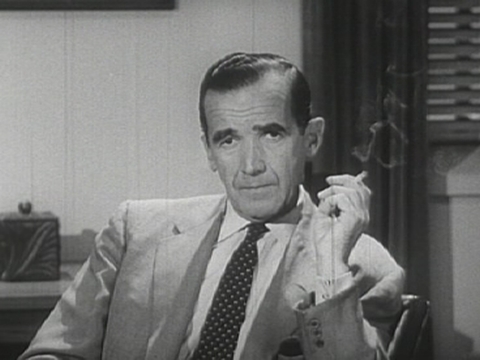
There were many of tight frames in the movie. It showed that this was a stressful time to the characters. Seeing such tight frames creates tension between the characters and shows how this political situation was terrifying for some and affecting not only peoples' personal lives but their professional too. When Murrow is doing his television program, it is done in close-up. Murrow is the center of attention and the only thing to focus on. With this, all your attention is on him and you listen to everything he says. I noticed during some of these scenes, the camera is shooting his profile but right above him is the television with him looking right at us.

I enjoyed Good Night and Good Luck and thought it was a very interesting film. There were some parts that didn't hold my attention completely but the techniques made the movie stand out.


Friday, October 8, 2010

Palmer GNGL Prompt 1

Although the content of Good Night and Good Luck was very good, the execution of the film was outdated for the present. I understand that the movie was filmed this way to be reminiscent of the time portrayed in the film. However, the film lacked variety and did not hold my attention.

The film lacked a wide variety of scene locations. While this technique helped to keep me grounded in the location, it failed to keep me engaged in the action of the scene. If memory serves me correct, the film spanned mainly over four locations, primarily the studio. Also, the close up frames did not have any positive effect on the film. The reason for this is because the majority of the character did not offer a wide variety of facial expressions and emotional content. The only real emotions expressed were happiness, sadness, and anger. The black and white did not help the film. It created a dull atmosphere and limited the visual affect that the film could have had on me and other viewers. Once everything has been considered, one can say that these affects made for a lackluster film. The movie had great substance, but it was visually exhausting.

Rayburn GNGL - Prompt #1


This movie is largely driven by dialogue, and so Clooney, in order to keep the interest of the modern American viewer, had to get creative with his use of camera work. I found that many of the elements he used subconsciously piqued my interest in the things Murrow said:

  • For one, the use of black and white was a way to emphasize the dialogue. Without color, which can so easily become a distraction, the brain has less elements to process, so, more availability for the words to really be heard.

  • Secondly, the shots typically were split between two main speakers. For instance, when McCarthy is televising his reply to CBS, the camera keeps both Murrow and McCarthy in the shot, focusing slowly back and forth between the two (see image). Even when McCarthy is not in focus, you find yourself staring at his blurred figure, wanting to see the face behind the words.

  • Also, despite the movie being exclusively indoors, Clooney uses camera work that pans from one speaker to another in moments of high-stress or overlapping dialogue, giving the scene a feeling of motion, almost mimicking an action movie.

  • Lastly, you find yourself listening so intently to Murrow because you are simultaneously watching people listen to Murrow. Every so often, during Murrow's particularly long monologues, the camera will show studio workers behind the booth staring intently at Murrow's face, soaking in every word he says. They are captivated by him, and so is the audience because of it. Not to mention David Strathairn's portrayal of Murrow is spot-on, down to every nuance, and if you don't always hear what he says, you can still marvel at the way he says it.

All of these elements took a potentially boring movie and made it into a captivating one. A movie that incites thought and reflection on our world today, and maybe causes a little more appreciation for the way the news used to be.

Nguyen Good Night and Good Luck


Good Night and Good Luck is a film that attempts to show us what happened during the time of the red scarce brought on by Senator McCarthy. The film itself uses different cinematic techniques to make the film feel as though it was made in 1953 as well as incorporating different forms of symbolism.
The most obvious technique is the fact that the movie is in black and white. The lack of color allows the audience to imagine as if they were watching the events of the red scare as it was happening in 1953. It adds a realistic yet fictional aspect to the film. The lack of color also shows that the situation with the communist was also black and white. It was clear that what McCarthy was doing is wrong, yet no one had the courage to stand up to him because they feared retaliation.
Another key technique are the constant close ups with the many characters. The close-ups allow Murrow, the newscaster, to be more intimate with the viewers. It creates a more intense and personal atmosphere throughout the movie because the red scare was a serious matter that endangered many innocent lives. The close-ups also showed that Murrow was taking the situation very personal even though he never really admitted it.
A subtle element of the film is that all the shots of the movie was made inside never outside in the open. Symbolically it shows that the communist threat was affecting people’s personal lives within there home and not just the outside world. The mere assumption that a person was affiliated with the communist party does not ruin just the individual’s life but the lives of his family as well.

Parker Good Night and Good Luck

When I first heard we were watching Good Night and Good Luck, I immediately went to look it up to see what the movie was about. When I did this, I saw that George Clooney and Robert Downey Jr. starred in it, my first thought was, "Wow, this is going to be a good movie." However, not even the cast of amazing actors could make up for the problems I had with this movie.

Once the movie started and I saw that it was in black and white, I was turned off right away. I don't particularly like black and white movies. They don't hold my attention very well.

Another issue I had with this movie is that it was all filmed inside the studio. There was no change in setting. There was no action. The whole movie was just people talking to each other about communism and then going on the TV to talk about it even more. I felt like it was just a blah movie that didn't dig into the plot enough. The most important issue was that I didn't really like the characters. When I watch a movie, I like static characters or characters that I can relate to. I felt like none of these characters were developed as much as I would have preferred, and of course, I couldn't relate to them at all.

While I like the message behind the movie, I can't say that I liked the movie as a whole.

Thursday, October 7, 2010

Parsons: Feeling of the 1950's


Good Night and Good Luc
k is filmed in a way that emulates the way television looked in the 1950’s. Because television was a new medium, usage of cameras and sound systems were in their infancy. All television had to be filmed in studio and close-ups were typical to show people’s facial expressions more clearly. This film creates this atmosphere that puts the audience into the 1950’s, not only by imitating the film techniques, but also by creating a tense, claustrophobic environment that shows the feeling of the time period. Indoor shots, many close ups, and tight framing made the film feel more like its time and affected the way I watched the movie.

Good Night and Good Luck was filmed in the best way for the affect that director George Clooney wanted to achieve. I watched the film with a feeling of unease. The movie itself was stark and beautiful with amazing shots and great visual images. Incorporating actual footage from the 1950’s, and pairing that with modern film done as antique made the movie really powerful because it made the audience feel like we were really experiencing the events surrounding the McCarthy hearings. Not only did the all indoor shooting make the film seem like it revolved in its own world, but it made us feel like their was no escaping the incidents of Murrow taking on McCarthy and we were right there through the pressure with CBS. The close ups and tight framing added to this feeling. The close ups made us feel like we were talking with Ed Murrow himself, and this was like his actual TV show from the 50's because it was usually just close up shots. Overall I liked the way Good Night and Good Luck was filmed because it added so much to the movie that would not have been there if filmed normally.

McElvaine. Good Night and Good Luck.


Edward R. Murrow would have been very successful in today's society. Murrow's claim to fame was tackling subjects that no one else had the guts to tackle. For example, in the film Good Night and Good Luck, Murrow takes the risk of questioning the soundness of Senator McCarthy's accusations that various American citizens were communists. During this period no one was willing to challenge McCarthy's accusations for fear of being accused themselves and Edward R. Murrow took the bull by the horns and stood up to McCarthy because he believed that what McCarthy was doing was ethically wrong.
Murrow would be successful today because people appreciate controversial opinions today. In contrast to the news of the 1950's, which was completely scripted and prerecorded, we now are capable of receiving live streaming news of many issues 24 hours a day. Because we have such access to the news we also appreciate hearing many different opinions of the news and different interpretations, similar to what Murrow offered during the 50's. Murrow is comparable to today's Bill Maher. Maher takes on controversial issues and awards people the opportunity to tell their side of the story in an open forum. Maher addresses issues that he has an ethical connection to and helps people to better understand both sides of a controversial issue. Maher and Murrow have very similar approaches to tackling difficult issues, Murrow just had much tighter constraints on what he could say on the news. Had Murrow been a reporter or a news caster today he would have had a much more open forum to express his political views and would have had much more success.